

Scalable Synthesis of Sustainable Single-Atom Catalysts: A New Hope for Vascular Healing
Professor Zhang Xiaodong’s team from Tianjin University has developed a scalable, highly biocompatible and atomically tunable two-dimensional single-atom biocatalyst and offered a novel solution for the long-term treatment of cardiovascular and cerebrovascular diseases. The findings were published in the international journal Nature Sustainability on December 22, 2025.
Single-atom catalysts (SACs) with high metal use and catalytic activity have been widely used in energy and biomedicine. However, the mass production of stable and homogeneous SACs still faces major challenges. Traditional production approaches for SACs lack precise control over the loading and dispersion of single atoms, while advanced methods, which can effectively mitigate these limitations, pose significant challenges for large-scale production due to complex processes and high costs.
To address this challenge, Professor Zhang Xiaodong’s team proposed a generalizable strategy for producing highly stable, low-cost SACs in a scalable and sustainable way. By combining quantum chemistry with machine learning, they screened SACs with the highest biocatalytic activity from nearly 20,000 atomic structures. These active atoms were then implemented in bioimplantable vascular stents, facilitating the mass production of single-atom biocatalysts.
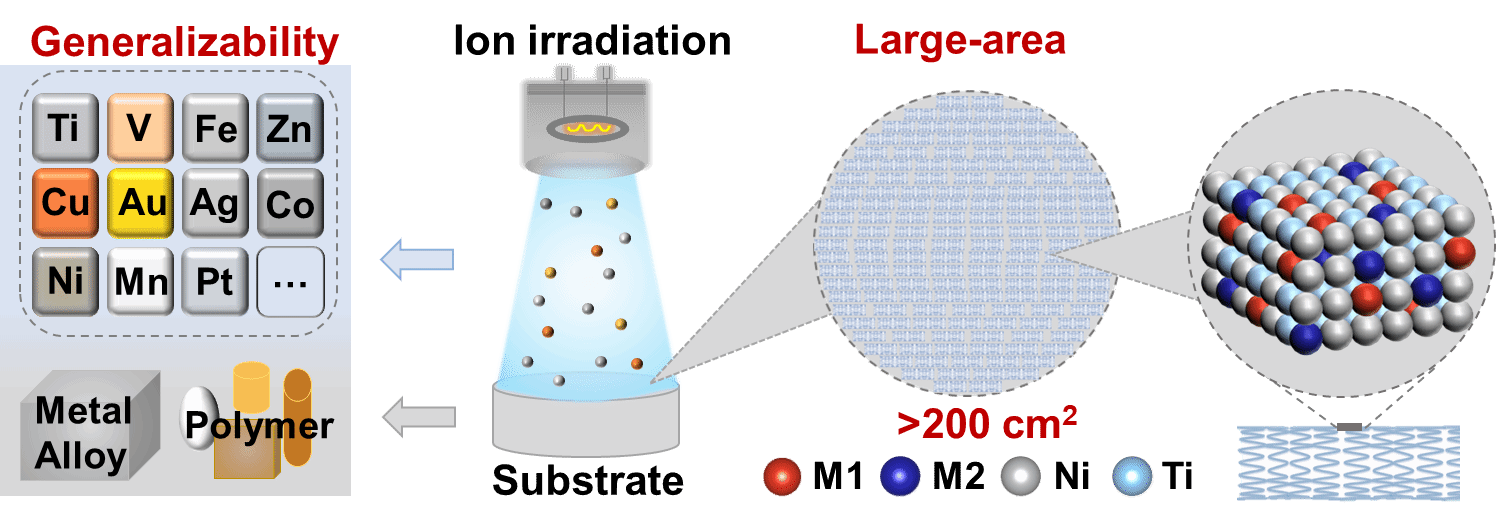
This innovative method boasts three key advantages: strong scalability, capable of fabricating SACs up to 200 cm² per batch in just hours; high versatility, successfully synthesizing 22 SACs on NiTi substrates on a large scale; and mild reaction conditions that preserve material structure, sustaining catalytic stability for up to 4 years.
The team developed new SAC vascular stents which demonstrated remarkable efficacy in inhibiting oxidative damage and vascular injury. Animal experiments demonstrated that the single-atom embedded stents not only facilitated vascular repair and healing but also provided long-term protection by sustainable biocatalytic capacity.
Notably, SACs provided a compelling alternative by offering lower costs. The natural abundance and low cost of material sources such as Co and V elements in the single atomic embedded stents maintain sustainable bioactivity far longer than natural enzymes and are recyclable at the end of use. “This work bridges cutting-edge basic research with critical clinical needs,” said Professor Zhang, “The innovative design and multifunctional properties of these single-atom engineered stents represent a paradigm shift in vascular therapy. They provide a durable, versatile and scalable solution that not only overcomes the limitations of current implanted materials but also paves the way for future advancements in managing brain diseases and beyond.”
Article Link: https://www.nature.com/articles/s41893-025-01713-7.
By: Li Hang
Editor: Zhao Yang
Weijin Road Campus: No. 92 Weijin Road, Nankai District, Tianjin
300072
Peiyangyuan Campus: No.135 Yaguan Road, Haihe Education Park, Tianjin
300350