

Research Team Achieves Breakthrough in Wireless Sensing
Recently, the Network and Cloud Computing team at Tianjin University has made significant strides in the field of wireless sensing. Their related research findings have been published in two papers in IMWUT (Proceedings of the ACM on Interactive, Mobile, Wearable and Ubiquitous Technologies), a top-tier international journal in the field of pervasive and ubiquitous computing.
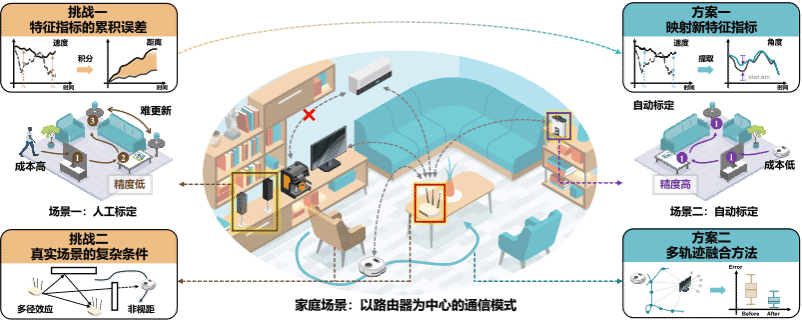
Currently, most smart home appliances still rely on user-initiated commands or specific sensors, making it difficult to comprehend users' dynamically changing states and needs seamlessly and continuously. In addition, cameras raise privacy concerns and wearable devices often lack convenience. The team has pioneered a novel approach. They have developed a new high-precision sensing application that eliminates the need for users to wear any devices. By leveraging the ubiquitous Wi-Fi signals in homes and analyzing their subtle variations caused by human activities, the system can perceive a person's location, state, and actions. This enables smart home appliances to deliver more precise and responsive services.
However, translating this high-precision sensing application from the lab to real-world homes presented two major practical bottlenecks: firstly, the system deployment was cumbersome, typically requiring professional technicians for repeated on-site calibration of device positions; secondly, severe signal obstruction and reflection in complex home environments led to inaccurate perception.
To address the issue of "deployment difficulty," the team innovatively turned their attention to the increasingly popular robotic vacuum cleaners in households, transforming them into "automatic data collectors" for environmental information. Users only need to let the robot vacuum cleaner perform a normal cleaning cycle once to complete system initialization, which completely eliminates the need for professional installation or manual measurements.
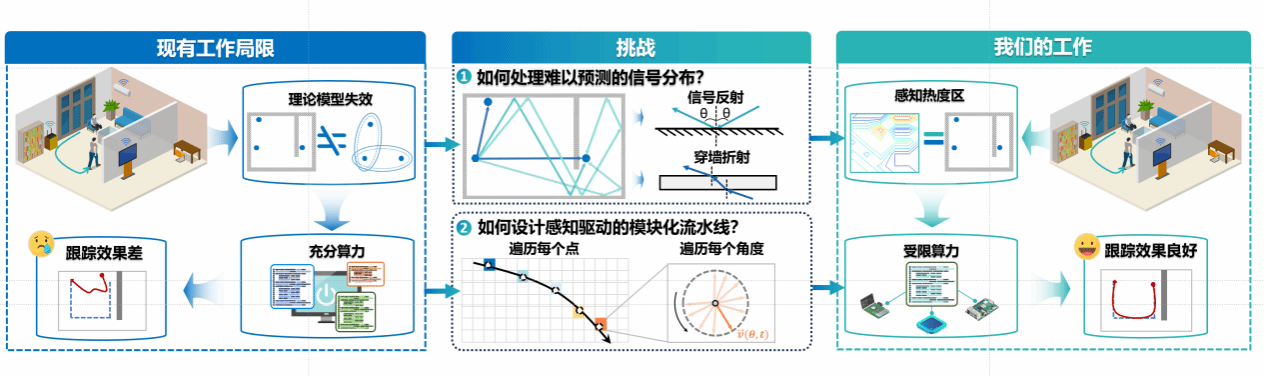
To address the issue of "low accuracy," the team abandoned the idealized assumption of unobstructed signals in traditional models. They, for the first time, developed a new theoretical framework tailored to the cluttered real-world household environment. The model is capable of precisely modeling the spread characteristics of Wi-Fi signals in complex environments. Experiments demonstrate that in typical cluttered home environments, the localization error of the new method is reduced by approximately 42% compared to the previous state-of-the-art approach. This marks the first time stable and reliable high-precision sensing has been achieved in real household settings.
The team proposed innovative methods and pathways targeting two challenges, achieving groundbreaking results. These two breakthrough achievements were accomplished under the guidance of Elite Associate Professor Tong Xinyu, and Professor Li Keqiu from the School of Computer Science and Technology, along with Assistant Research Fellow Chen Sheng from the School of Cybersecurity. Doctoral candidates Tan Renrui and Meng Xuanqi are the respective first authors of the papers. Dr. Tong Xinyu stated that the research outcomes not only clear key obstacles for wireless sensing technology to reach millions of households but also provide core technical support for building smarter and more considerate living environments in the future.
By: Liu Hui
Editor: Du Jiachen, Xie Donglin
Weijin Road Campus: No. 92 Weijin Road, Nankai District, Tianjin
300072
Peiyangyuan Campus: No.135 Yaguan Road, Haihe Education Park, Tianjin
300350