

New Progress in Designing Wobble-Scheme Heterojunction for Tumor Therapy
A research team led by Jin Xinghua from the School of Pharmaceutical Science and Technology at Tianjin University, collaborating with a team led by Li Xichuan from the School of Life Sciences at Tianjin Normal University, has developed a novel "wobble-scheme" heterojunction designed to enhance catalytic cancer therapy. The breakthrough, entitled "Design of a Wobble-Scheme Heterojunction for Catalytic Cancer Therapy", has been published in the well-known nanoscience and nanotechnology journal Small. The research was supported by the Instrument Testing Center of the School, utilizing its advanced magnetic resonance, spectroscopy, and pharmaceutical preparation platforms.
This study put forward an innovative design concept of a "Wobble-Scheme Heterojunction", utilizing COF enolimine-ketoenamine tautomerism triggered by the tumor microenvironment to achieve dynamic reversible regulation of band structure and charge transfer direction. By combining a dual donor-acceptor structure with the PCET mechanism, it effectively reduced the H₂O₂ generation barrier, significantly enhanced photocatalytic efficiency, and ultimately constructed an intelligent, self-supplying ROS nanocatalytic therapy platform. This breakthrough paves a new direction for the rational design of smart-response heterojunctions in the field of nanocatalytic medicine.
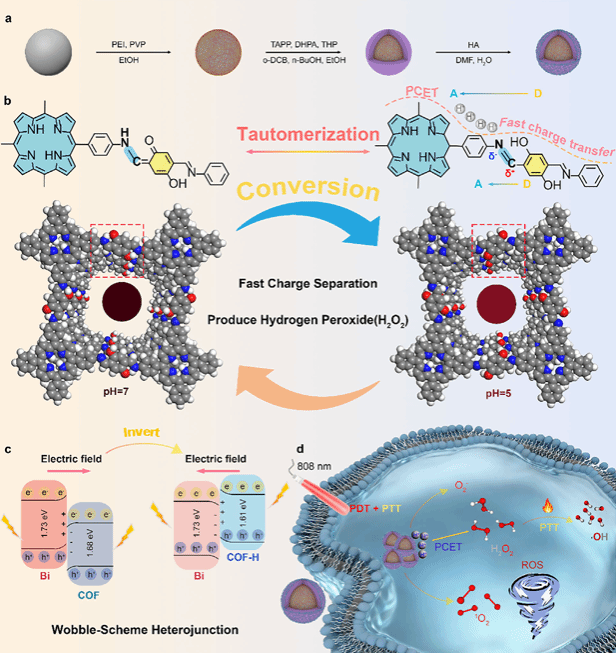
The team from the Instrument Testing Center of the School provided solid testing technical support for this study: the structure and activity of heterojunction nanomaterials were systematically characterized using Bruker EMX plus electron paramagnetic resonance spectrometer (EPR), Bruker AVANCE III nuclear magnetic resonance spectrometer (NMR), Bruker TENSOR 27 infrared spectrometer (IR), and PerkinElmer Lambda 750 ultraviolet/visible/near-infrared spectrometer; The preparation of spherical nanoparticles was completed using a GEA Niro Panda high-pressure homogenizer and a Hitachi CP100NX ultracentrifuge; Malvern Nano ZS dynamic light scattering (DLS) was used to measure the particle size distribution and Zeta potential of nanoparticles. The School of Pharmaceutical Science and Technology, Medical College, Tianjin University serves as the first corresponding author affiliation for this paper.
Link of the article:
https://onlinelibrary.wiley.com/doi/10.1002/smll.74572
By School of Pharmaceutical Science and Technology
Editor: Sun Xiaofang
Weijin Road Campus: No. 92 Weijin Road, Nankai District, Tianjin
300072
Peiyangyuan Campus: No.135 Yaguan Road, Haihe Education Park, Tianjin
300350