

Training engineers to keep asking why
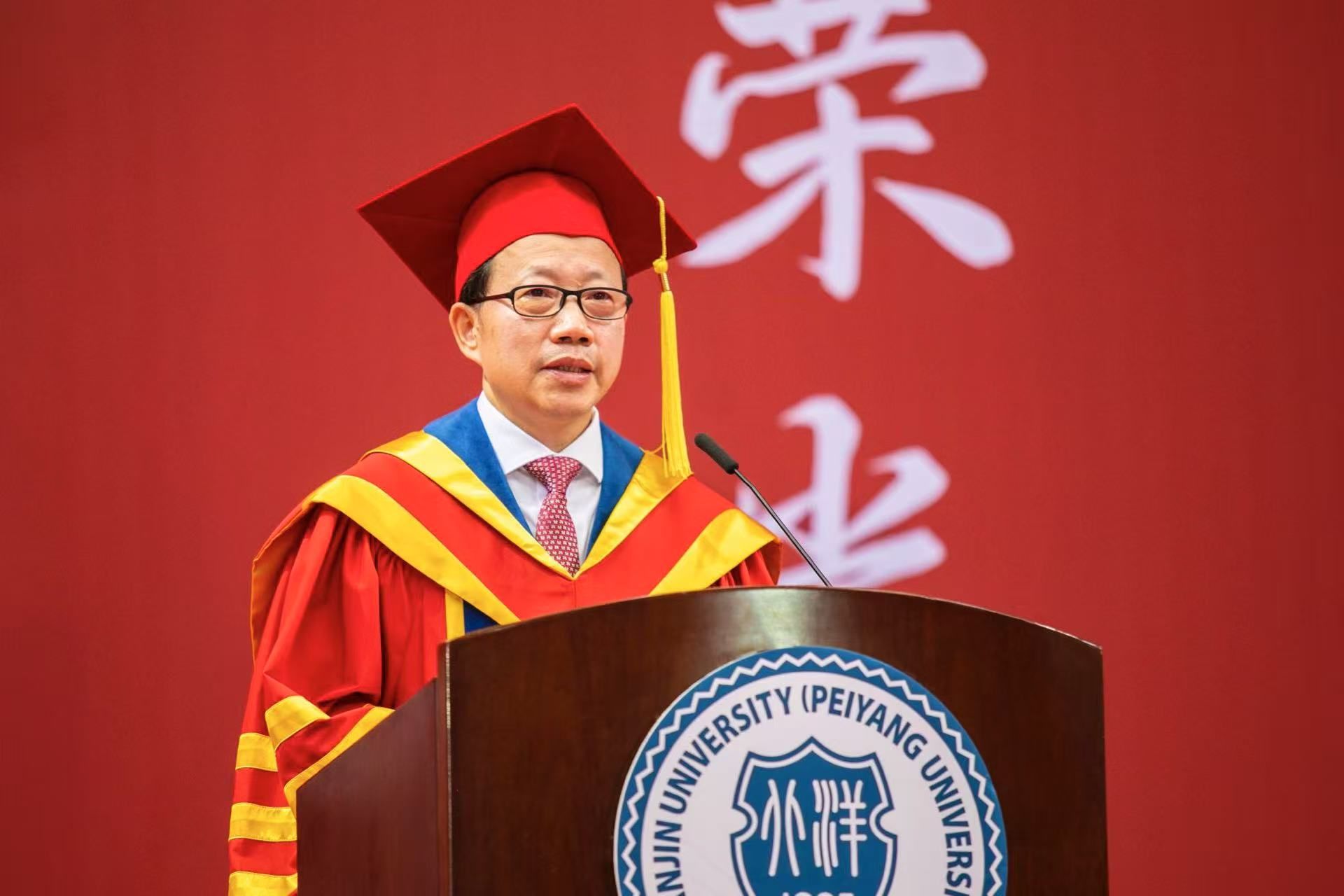
As president of Tianjin University, I am often caught off guard by students' questions. Once, Zhao Junting, a senior in the School of Future Technology, asked me: "When AI can do everything, what is the point of studying engineering?" ChatGPT arrived the year he enrolled; by his sophomore year, robots had learned to dance.
His four years have coincided with a period in which AI has begun to change what engineering work looks like, prompting schools around the world to ask a more fundamental question: when technology can "do" things by itself, what kind of engineers should we train?
The future demands not more engineers who know how to do things, but a different kind — engineers who know what to do, why, and for whom.
This rests on three essential qualities: judgment, responsibility and systems thinking. AI can assist engineers in their work, but it cannot take responsibility for the consequences of their choices. The more powerful technology becomes, the more precious these three qualities grow.
This is not a concern peculiar to Tianjin University. The World Economic Forum's Future of Jobs Report 2025 sends much the same signal: over the next five years, AI and big data will be the fastest-growing skills, yet employers still prize analytical thinking above all — alongside creativity, curiosity and lifelong learning. One thing can be read from the report: what is being automated is execution, and what is rising in value is judgment, responsibility and systems thinking. Worldwide, engineering education stands at the same crossroads.
Judgment grows out of real problems. Reformers around the world have converged, almost without coordination, on the same method: project-based learning.
In 2000, the Massachusetts Institute of Technology and three Swedish engineering universities launched the CDIO initiative (Conceive-Design-Implement-Operate), which today spans more than 200 institutions worldwide. At Olin College of Engineering in the United States, students begin hands-on projects in their first semester and finish with a company-sponsored capstone. Chinese universities are making the same exploration.
At Tianjin University, first-year students sit on the floor of our Future Learning Center for Design and Intelligent Manufacturing, assembling motors, wheels and circuit boards into a line-following car. We keep raising the bar, because the students soon outperform the targets we set. Once, at the center, I saw a student named Wu Lvke crouched on the floor, absorbed in his work, sweat on his brow.
Over four years he moved from phone gimbals to EEG acquisition boards, and on to an imaging device for inspecting municipal pipelines. I often tell our faculty that such "tinkering" is the real classroom of engineering education.
Judgment, in this sense, is forged not in classrooms where every question comes with a known answer, but when students must test an idea, confront its limits, revise it and explain why one solution is better than another.
The second test is responsibility — answering the question "for whom". When AI can take over so much of the technical work, the question of whom technology should serve becomes all the more pressing. Tianjin University operates the National Facility for Earthquake Engineering Simulation, an apparatus capable of replicating earthquakes of magnitude 9.
It grew out of a shared wish after the Wenchuan earthquake of 2008 — the pain of that year drove us to turn real disasters into questions we can simulate and verify again and again in the laboratory, so that each tragedy becomes the basis of stronger protection the next time.
We at Tianjin University believe that the ground we shake is meant to keep people safe. Ma Yan, a master's student in chemical engineering, has also left a deep impression on me. She told me that her goal in working on green catalysts is simple: to make an important industrial technology cleaner, cheaper and more accessible to more people. In her, I see the answer planted by engineering ethics: technology must be accountable to real people and to the real world.
The third test is systems thinking. Few complex problems today can be solved by a single discipline. Climate change, the energy transition and aging populations are cross-disciplinary challenges that also demand cross-border collaboration. I have long believed that the deeper industrial technologies converge, the more engineers need systems thinking and the ability to integrate knowledge across fields.
That is why we pool talent from clinical medicine, medical schools and intelligent sciences in our brain-computer interface research, and why first-year students build "carbon-neutral cabins," learning an entire energy system from supply to use. We are shifting engineering education from being discipline-oriented to being domain-oriented, sending our teachers into companies to study what jobs will look like a decade from now. None of this is unique to one university; it is the shared direction of the world's leading engineering schools.
Engineers are trained to solve problems that rarely stop at national borders. Climate change, energy and public health all demand solutions that can work across different contexts. Meanwhile, rapid technological change is reshaping industries and making it harder to predict what skills engineers will need in the years ahead.
For Tianjin University, this uncertainty raises two questions: What should an engineering university remain true to, and how must it change?
Founded in 1895 as China's first modern university, Tianjin University has long linked engineering education to the country's development. That purpose remains, but the demands on engineers have changed. Technical knowledge alone is not enough; they must also learn to tackle practical problems and understand the people their work affects.
These questions also shaped the Tianjin Initiative for International Engineering Education Cooperation, launched by Tianjin University and partner institutions in 2025. The initiative offers a platform for universities to compare experiences and explore a shared question: how can engineering education prepare students for problems that are still taking shape?
At our orientation ceremony this September, one student said: "The truly important questions are never written at the end of a textbook chapter. We should dream big." To dream big, in practice, means training engineers who ask "why."
In an age when AI can answer more and more questions of "how," those who keep asking "why" — and take responsibility for their answers — will help shape the future. Preparing such engineers is not a guarantee against uncertainty. It is one of the surest ways to meet it.
Weijin Road Campus: No. 92 Weijin Road, Nankai District, Tianjin
300072
Peiyangyuan Campus: No.135 Yaguan Road, Haihe Education Park, Tianjin
300350