

Prof. Zhiyuan Shi's Team at Tianjin University Reviews Light-, Ultrasound-, and Magnetic Field-Controlled Gene Regulation
The 2026 Nobel Prize in Physiology or Medicine was awarded to three scientists for their groundbreaking discoveries in light-gated ion channels and optogenetics, bringing the concept of controlling cells with light into the spotlight. By introducing light-sensitive switches into specific cells, scientists can precisely regulate cellular activity using light, providing powerful tools for investigating brain function and disease mechanisms.
Recently, Professor Zhiyuan Shi's team at the School of Pharmaceutical Science and Technology, Tianjin University, in collaboration with other researchers, published a review entitled "Remote-Controlled Genetic Circuits: Light, Ultrasound, and Magnetic Fields for Programmable Gene Regulation" in Advanced Materials. The review systematically examines how these three external physical stimuli can be converted into intracellular signals to regulate gene expression, offering valuable insights into remote cellular control.
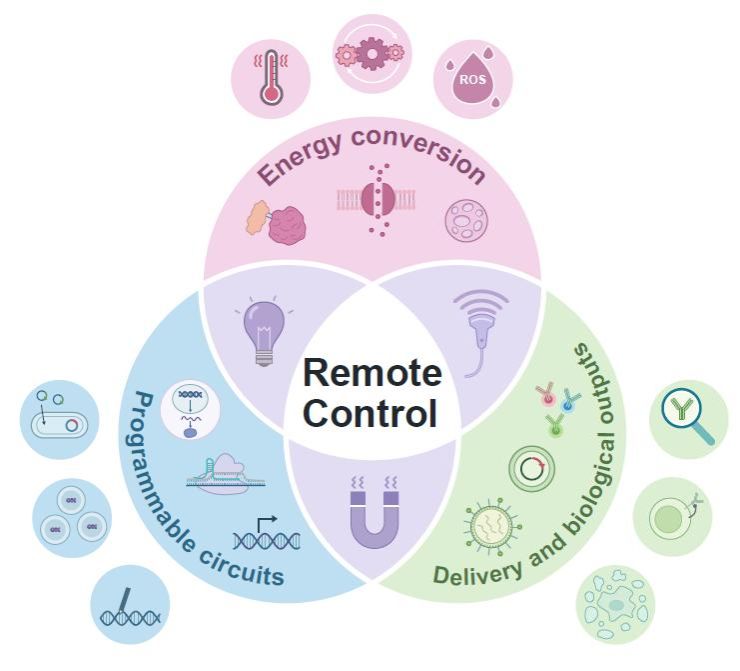
Light has limited penetration depth in biological tissues, and controlling cells in deep tissues often requires implanted light sources or other auxiliary technologies. This raises an important question: Can ultrasound or magnetic fields, which can reach deeper tissues, enable remote control of cells and gene expression?
Sonogenetics and magnetogenetics offer promising approaches to addressing this challenge. Ultrasound can penetrate deep tissues and be focused on specific target regions, while magnetic fields exhibit excellent tissue penetration. With suitable responsive materials and biological components, these external stimuli can be converted into intracellular signals that regulate cellular activity or gene expression. These properties highlight the potential of sonogenetics and magnetogenetics for deep-tissue regulation and precision therapies, although further research is needed to improve control precision and clarify their mechanisms and safety.

Figure 1. From external physical stimuli to gene expression: How remote control systems work.
Interested in controlling cells remotely but unsure where to begin? This review offers a useful starting point.
The article systematically summarizes the biological pathways and gene regulation strategies responsive to light, ultrasound, and magnetic fields. It compares how cells sense external signals, transmit them intracellularly, and ultimately regulate gene expression.
A genetic circuit can be understood as an intracellular control system composed of biological components that determine when a gene is activated and how much protein is produced. Beyond comparing the advantages, limitations, and applications of these three technologies, the review explores how genetic circuits can be engineered to integrate multiple inputs, retain memories of previous stimulation, and adjust their functions through feedback.
From selecting appropriate physical stimuli and establishing intracellular response pathways to designing genetic circuits for specific tasks, this review provides an accessible introduction for researchers interested in the field and offers guidance for developing new strategies for remote gene regulation using light, ultrasound, and magnetic fields.
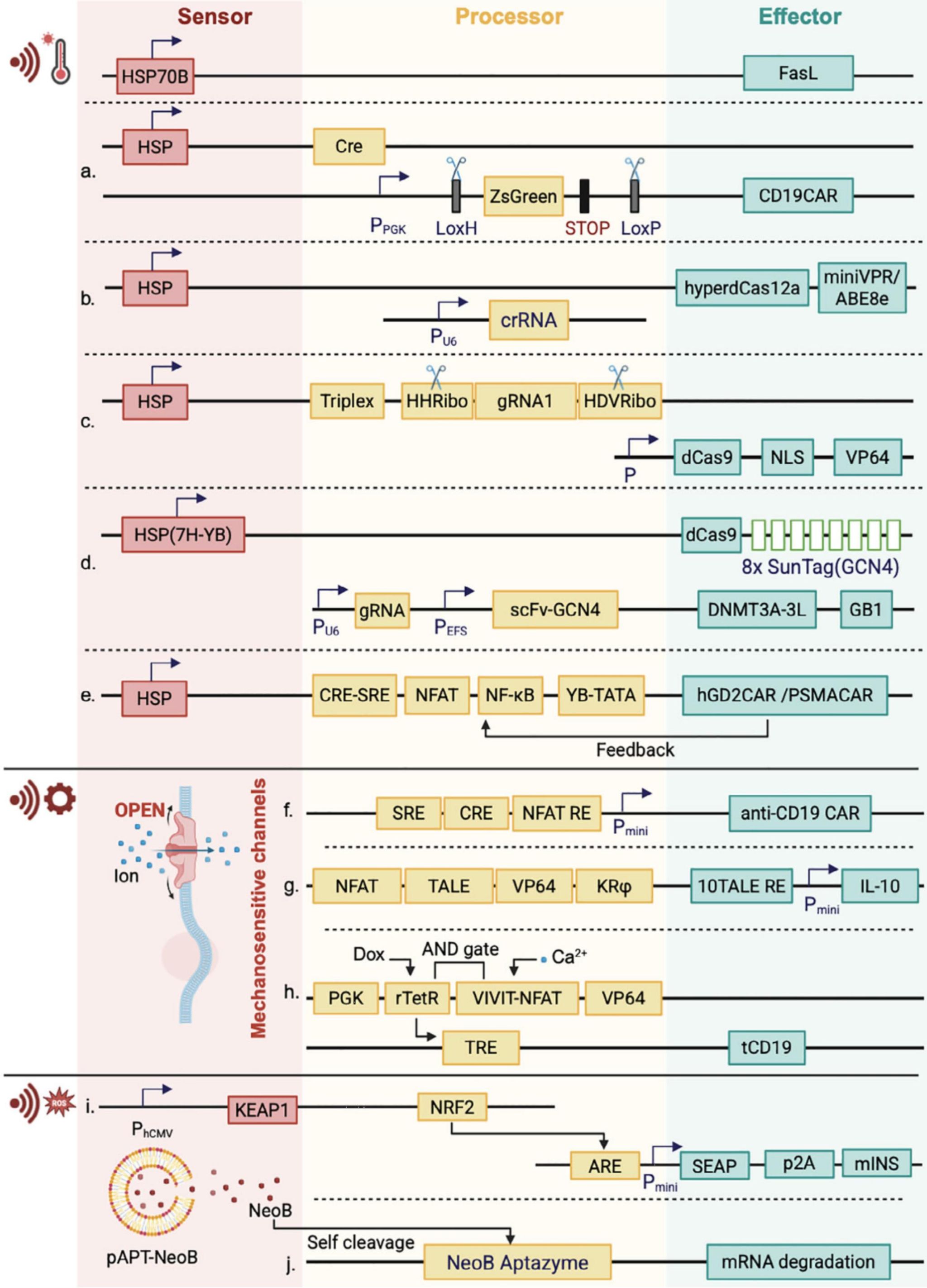
Figure 2. Ultrasound-mediated gene regulation: Representative responsive pathways and genetic circuits in eukaryotic cells.
Tianjin University is the first-affiliated institution of the publication. The research was primarily conducted by PhD student Xinming Yu and master's students Xiaomiao Yu and Shang Jia from the School of Pharmaceutical Science and Technology, Tianjin University. This work was supported by the National Natural Science Foundation of China, the State Key Laboratory of Advanced Medical Materials and Devices, the Natural Science Foundation of Tianjin, and other funding programs.
About the Corresponding Author
Prof. Zhiyuan Shi is a doctoral supervisor at the School of Pharmaceutical Science and Technology, Tianjin University. She studied Neuroscience and Behavioral Biology at the University of Göttingen, Germany, before earning her master's degree in Biomedical Engineering and PhD in Chemistry from RWTH Aachen University, Germany. She received her PhD with the highest distinction (Summa Cum Laude) and joined Tianjin University as a full-time faculty member in 2023.
Her research focuses on sonopharmacology, sonogenetics, polymer mechanochemistry, and cancer immunotherapy, with particular emphasis on developing novel strategies to regulate drug activity and cellular functions using external physical stimuli such as ultrasound. Her work has been published in prestigious journals, including Nature Chemistry and the Journal of the American Chemical Society.
She has served as principal investigator on research projects funded by the Ministry of Education's Overseas Talent Recruitment Program, the National Natural Science Foundation of China, and the Natural Science Foundation of Tianjin. Her honors include the Chinese Government Award for Outstanding Self-Financed Students Abroad and the Borchers-Plakette Award from RWTH Aachen University.
Students with backgrounds in pharmacy, chemistry, materials science, biology, biomedical engineering, or related fields are encouraged to apply for master's or PhD positions in her research group. Interested candidates are welcome to send their CV and a brief statement of research interests to zhiyuan_shi2023@tju.edu.cn. Academic inquiries and discussions are also welcome.
By School of Pharmaceutical Science and Technology
Editor: Sun Xiaofang
Weijin Road Campus: No. 92 Weijin Road, Nankai District, Tianjin
300072
Peiyangyuan Campus: No.135 Yaguan Road, Haihe Education Park, Tianjin
300350