

New Membrane Design Advances Carbon Capture
A research team at Tianjin University has developed a new type of all-organic mixed-matrix membrane that could offer a more efficient and scalable approach to carbon capture, addressing a longstanding challenge in combining high separation performance with stability and processability.
The study was published online in Nature Energy on Oct. 7 under the title “All-organic mixed-matrix membranes with single-crystal covalent organic frameworks for carbon capture.”
Carbon capture is considered an important technology for reducing emissions from energy-intensive industries. Among existing approaches, membrane separation has attracted growing attention because of its potential advantages in energy efficiency and environmental performance. Yet separating CO2 from industrial flue gas remains challenging, as carbon dioxide is often present at relatively low concentrations and in large gas streams, requiring membranes that can allow CO2 to pass through rapidly while effectively separating other gases and maintaining stable performance over time.
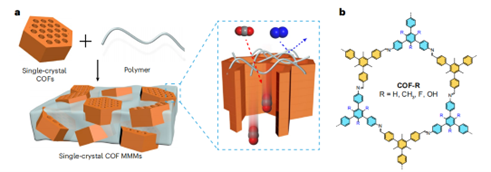
Schematic illustration of an all-organic mixed-matrix membrane incorporating single-crystal covalent organic frameworks
Mixed-matrix membranes, which combine the processability of polymers with the efficient molecular transport properties of porous fillers, have long been regarded as a promising option. Their practical development, however, has been constrained by compatibility problems between the two components.
When inorganic porous particles are incorporated into polymers, they tend to aggregate or settle, while defects can form at the interface. Conventional approaches often seek to strengthen interactions between the filler and polymer, but excessively strong interactions can stiffen polymer chains near the interface or block the pores of the filler. As a result, the amount of porous material that can be incorporated into such membranes is often limited, leaving gas transport largely controlled by the polymer matrix.
To address the problem, the Tianjin University team, led by professor Jiang Zhongyi and He Guangwei, took inspiration from the cell membranes and proposed what the researchers describe as a “weak-interaction inlaying” strategy to fabricate a class of all-organic mixed-matrix membranes.
Instead of simply maximizing the interaction between the porous filler and the polymer, the researchers coordinated two sets of interactions: those between the filler and polymer and those among filler particles themselves. By designing fillers with low surface energy, the team was able to maintain sufficient interfacial adhesion while suppressing particle aggregation and sedimentation.
The researchers used single-crystal covalent organic frameworks, or COFs, as porous fillers and embedded them uniformly within a polymer matrix at high loading. The resulting all-organic mixed-matrix membrane retained the flexibility and solution processability of the polymer while allowing the ordered pores of the COF crystals to serve as dominant pathways for rapid CO2 transport.
Tests using simulated flue gas showed an order-of-magnitude increase in CO2 permeability, setting a new record. The membrane achieved about 70 percent of the theoretically predicted permeability of a pure COF membrane, according to the study.
The membrane also showed strong long-term stability, with its performance remaining consistent over extended operation and under test conditions containing water vapor, sulfur oxides and nitrogen oxides, contaminants commonly found in industrial flue gas.
A preliminary techno-economic analysis further suggested that, under the process and cost assumptions used in the study, the carbon capture cost could be about 38 U.S. dollars per tonne of CO2, indicating the technology’s potential to reduce the economic cost of carbon capture.
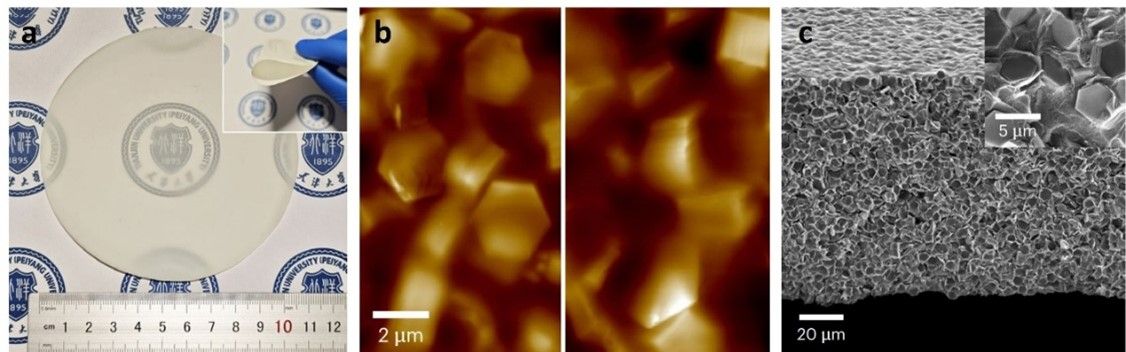
Membrane morphology and microstructure
The researchers said the work provides a new design principle for mixed-matrix membranes by shifting the focus from simply strengthening filler-polymer interactions to precisely balancing multiple interfacial forces.
The approach could help reconcile three requirements that have often been difficult to achieve simultaneously in membrane development: high separation performance, long-term stability and ease of processing.
The team believes the strategy could support further development of mixed-matrix membranes for carbon capture from flue gas in power generation, cement and steel production, potentially helping bridge the gap between laboratory-scale membrane research and industrial applications.
By: Qin Mian
Weijin Road Campus: No. 92 Weijin Road, Nankai District, Tianjin
300072
Peiyangyuan Campus: No.135 Yaguan Road, Haihe Education Park, Tianjin
300350