

From New Year Prints to Sweet Malt Candy: International Students Experience the Little New Year
As the Spring Festival approaches, the Feng Jicai Museum at Tianjin University in north China’s Tianjin Municipality has taken on a festive atmosphere. Lanterns illuminate vine-covered pathways, and traditional folk performances draw visitors into the celebratory spirit of the Chinese New Year.
Several Thai students participated in the museum’s Spring Festival activities including printing New Year paintings, writing the character “Fu,” and watching performances rooted in intangible cultural heritage. Through these hands-on experiences, they gained a more direct understanding of the festival and the traditions behind it.
Vesarachkitti Kirana, stood before a series of traditional New Year paintings, studying them closely. It was her first Spring Festival in China, and she said the experience allowed her to understand the festival “on a much deeper level.”
“I used to know that the Spring Festival is the most important holiday in China. It is lively and places great importance on family and tradition. But today’s experience helped me truly understand its meaning,” she said.
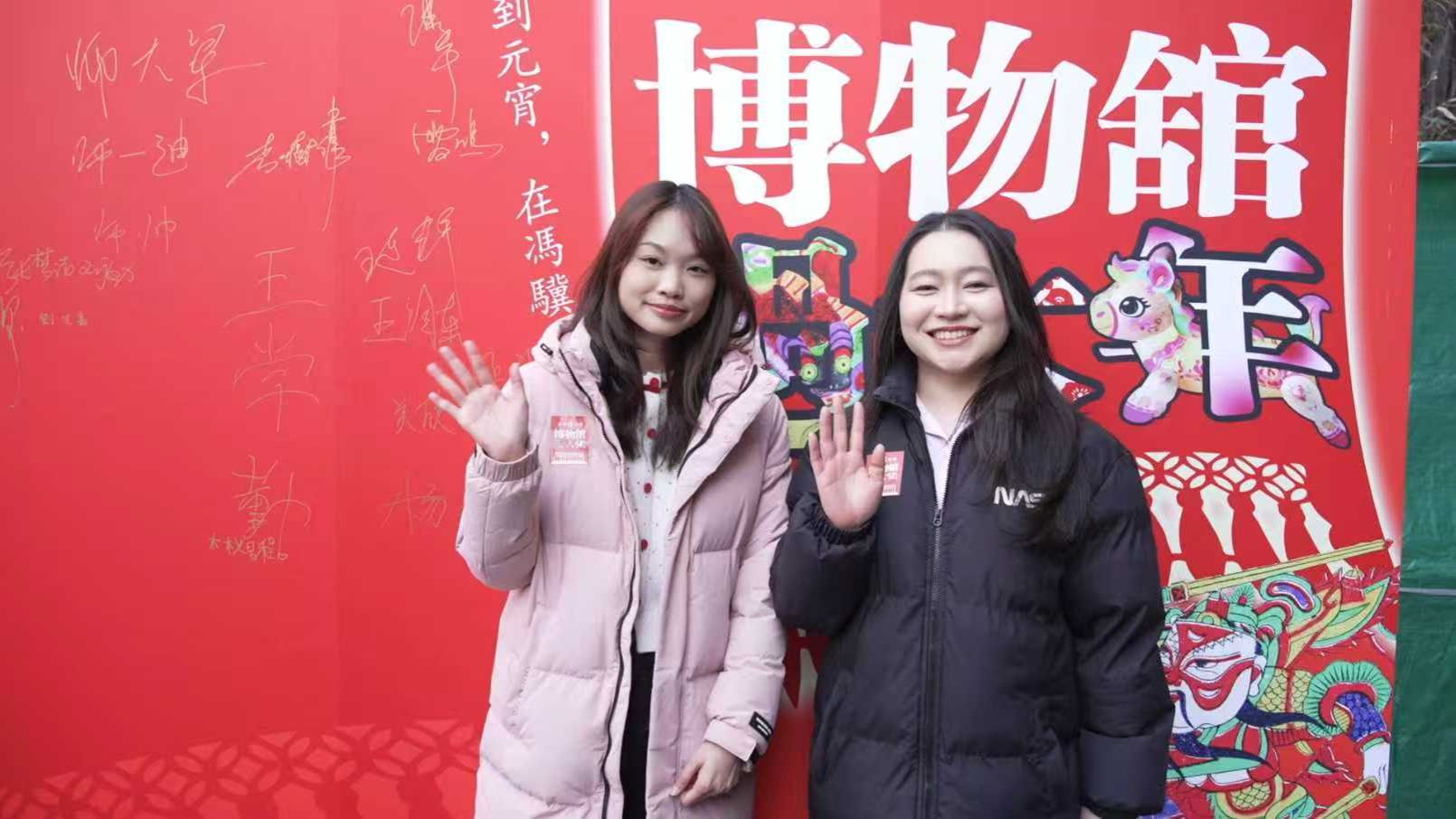
For generations, New Year paintings have served as an important way for families to bid farewell to the old year and express wishes for peace and prosperity in the new one. In the museum’s exhibition hall, displays introduce major production centers such as Yangliuqing in Tianjin and Foshan in Guangdong. Woodblock carving tools, multi-layer printing techniques and representative works are presented in sequence.
Images of door gods, babies holding carp and the God of Wealth appear in vivid colors, symbolizing auspicious wishes. As she listened to the explanations and observed the texture of woodblocks and layered printing techniques, Kirana said she came to better understand the deeper meanings behind the festival.
“Door god paintings are not merely decorations for the festival. They carry people’s wishes for safeguarding the home, family harmony and good fortune in the new year,” she said. She added that once she understood the blessings and symbolic meanings behind the images, she realized that the Spring Festival is not only about festive scenes, but also about a tradition passed down through generations.
Located on the Tianjin University campus, the Feng Jicai Museum houses thousands of artifacts and artworks. Exhibitions such as The History of Chinese New Year Paintings highlight its role in preserving and promoting traditional Chinese culture.
During the 2026 Spring Festival, the museum became an important venue for Thai students who remained on campus to explore Chinese traditions.
At the event, renowned Chinese writer and cultural scholar Feng Jicai delivered a lecture on Spring Festival customs. He noted that throughout China’s long agrarian history, the Spring Festival has been the occasion when the Chinese people place their deepest hopes and emotions at the heart of family and social life. Traditions such as posting couplets, hanging lanterns, sharing reunion dinners and setting off firecrackers remain among the most emotionally significant expressions in daily life.
“The ideals and aspirations people hold for life, including happiness, safety, harmony, health, fulfillment and family reunion, form the core of Spring Festival traditions,” Feng said. “For this reason, the festival offers an important window into Chinese culture and remains one of the most distinctive traditions of Chinese civilization.”
The United Nations Educational, Scientific and Cultural Organization (UNESCO) on December 4, 2024 inscribed Spring Festival, social practices of the Chinese people in celebration of traditional new year on the Representative List of the Intangible Cultural Heritage of Humanity.
“We want to invite international students who remain on campus to share in the Spring Festival, a cultural heritage passed down for thousands of years and shared by humanity,” Feng said. “They are not just guests, but participants in this celebration.” Feng added that recognition of the Spring Festival as part of humanity’s shared heritage will help deepen international understanding of China while strengthening cultural confidence and continuity.
“I hope everyone here can experience the warm sense of ritual in Chinese folk traditions and gain a better understanding of the customs associated with the Spring Festival,” Feng said. He added that through the continued participation of successive generations, the Spring Festival has been preserved and passed on, remaining an important part of family and social life in China.
After listening to the lecture, VESARACHKITTI said she gained a more systematic understanding of the festival. She noted that through visual forms such as New Year paintings, blessings and aspirations are made tangible, allowing traditional culture to continue in daily life.
Speaking about Spring Festival traditions in her homeland, she said that in Thai Chinese families, people also pay respect to ancestors, give red envelopes to elders and children, and gather for reunion meals.
“Although we live in different countries, the emphasis on family and the transmission of tradition is the same,” she said.
Gao Nicha, a Thai student majoring in bioengineering at Tianjin University, also participated in the activities. It was not her first Spring Festival in China.
When she was studying at a Chinese high school, only four international students remained on campus during the holiday. Teachers and dormitory staff invited them to share reunion dinners at their homes.
“That experience allowed me to truly feel the warmth of family during the Spring Festival,” she said.
Writing Spring Festival couplets and the character “Fu” stood out to her during this year’s activities.
“Our teacher told us that placing the character ‘Fu’ upside down symbolizes that ‘good fortune has arrived,’” she said. “Through what may seem like a small tradition, I began to understand how everyday symbols in Chinese culture carry layered meanings and shared memories.”
She also observed the traditional custom of offering malt candy to the Kitchen God.
“‘Offering sweet malt candy to the Kitchen God’ embodies good luck, auspicious blessings and hopes for well-being in the coming year in its sweet and heartfelt manner,” she said.
At the performance venue, students occasionally raised their phones to record traditional dances and cultural displays.
Through firsthand participation, the Spring Festival became a shared cultural experience for these international students.
By: Qin Mian
Weijin Road Campus: No. 92 Weijin Road, Nankai District, Tianjin
300072
Peiyangyuan Campus: No.135 Yaguan Road, Haihe Education Park, Tianjin
300350