

Chinese Researchers Break Through in Organic Battery Technology, Create a Safer, More Durable Alternative
Chinese scientists have developed a new type of organic lithium-ion battery that is safer and more flexible, and addresses longstanding performance bottlenecks.
The technology was jointly developed by scientists from Tianjin University and South China University of Technology. The study was published online in the international journal Nature on Thursday, Beijing time.
The team, led by Professor Xu Yunhua from Tianjin University, has engineered an organic cathode material that significantly enhances the energy density and charging speed of lithium-ion batteries. This addresses key challenges in practical application of traditional organic batteries, such as low energy density.
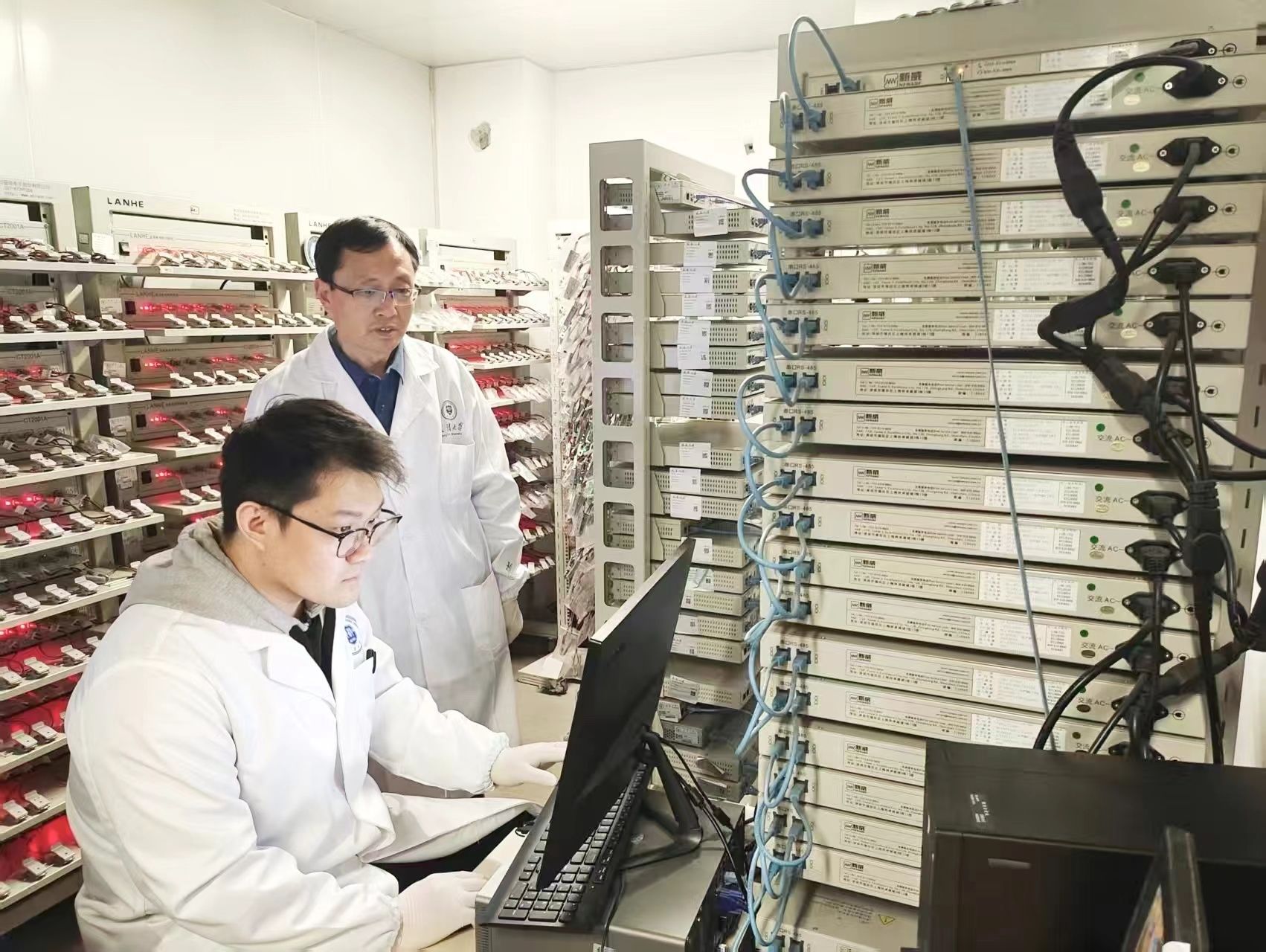
Commercial lithium-ion batteries today rely on inorganic cathode materials, such as those containing cobalt and nickel. These materials face growing concerns over resource scarcity, safety risks, lack of mechanical flexibility, and performance drop in extreme conditions. In response, the scientific community has increasingly turned its attention to organic electrode materials, which are abundant, environmentally friendly, and structurally adaptable.
Organic materials are often referred to as the “green battery star” in the field of energy storage due to their renewable source, customizable molecular structures, and lightweight, flexible properties. However, one major challenge has persisted: achieving high energy density while maintaining fast lithium-ion transport and structural stability under a range of operating conditions.
To tackle this challenge, the Tianjin University-led team utilized a newly developed n-type conductive polymer electrode material known as poly (benzofuran dione) (PBFDO), which demonstrates exceptional electronic conductivity, fast lithium-ion transport, and high specific energy storage capacity.
Using this new cathode, the team developed a pouch battery. The battery delivers an energy density exceeding 250 watt-hours per kilogram (Wh/kg), outperforming conventional lithium iron phosphate (LFP) batteries, which typically offer around 160–200 Wh/kg. More impressively, the new battery demonstrates outstanding thermal stability, operating stably in a temperature range from -70°C to 80°C.
The battery also exhibits exceptional mechanical resilience and superior safety profile. In tests, the organic cathode maintained structural integrity and full capacity even after being bent, or compressed. Furthermore, the Ah-level pouch battery successfully passed a puncture safety test, a standard test used to assess the risk of thermal runaway or fire in lithium batteries. The battery did not catch fire or explode, demonstrating robust safety features.
“This research breaks through the traditional constraints of battery technology in terms of resource dependence and environmental impact,” said Professor Xu Yunhua, the lead researcher. “It not only matches the energy density of commercial batteries but also offers superior safety and a much wider operational temperature range.”
What sets this development apart is its readiness for practical application. The research team is already working on scaling up the technology with industrial production, with plans to establish a pilot-scale manufacturing line for organic batteries.
The team’s findings open the door to a range of future applications, particularly in the fields of flexible electronics, wearable devices, and energy storage systems that require lightweight, adaptable, and safe power sources.
As the world intensifies its push for clean energy and sustainable technologies, the development of organic-based batteries could signal a paradigm shift in the energy storage sector. With eco-friendly materials, superior performance, and mechanical flexible, these batteries offer a compelling alternative to the current generation of inorganic lithium-ion systems.
Tianjin University and its research partners are now focused on scaling up production, optimizing manufacturing processes, and exploring industry collaborations to bring the technology to market. Their progress underscores the vital role of academic research in driving innovation and sustainability, especially in the context of the global transition toward renewable energy.
This innovation not only advances the science of organic batteries but also brings the world one step closer to a future of safe, sustainable, and high-performance energy storage.
By Sun Xiaofang
Weijin Road Campus: No. 92 Weijin Road, Nankai District, Tianjin
300072
Peiyangyuan Campus: No.135 Yaguan Road, Haihe Education Park, Tianjin
300350